Shell Thermal Conversion Technologies
Thermal Distillate Cracking technology
Overview
 Shell
Thermal Distillate Cracking technology provides a cost-effective solution to convert heavy distillate product like heavy gasoil, or vacuum gasoil, to light
gasoil. Given the low investment costs, the ease of operation and the great
return, this technology has been selected as the cracking technology of choice
in 30% of Shell's refineries. Thermal cracking of heavy gasoil takes place in the liquid phase in a
furnace, at elevated pressure and temperature.
Shell
Thermal Distillate Cracking technology provides a cost-effective solution to convert heavy distillate product like heavy gasoil, or vacuum gasoil, to light
gasoil. Given the low investment costs, the ease of operation and the great
return, this technology has been selected as the cracking technology of choice
in 30% of Shell's refineries. Thermal cracking of heavy gasoil takes place in the liquid phase in a
furnace, at elevated pressure and temperature.
A small part of the heavy gasoil is
converted to residue and light products. The majority of the heavy gasoil is
converted to light gasoil.
The feed and product requirements of the
Thermal Distillate Cracking process are flexible, and the process has the
capability to optimize conversion through adjustment of the HGO recycle rate.
Given that the endpoint requirements for light gasoil are likely to change in
the near future, this process provides an opportunity for refiners to meet those
revised requirements at a very moderate investment.
Process Description
Distillate feed (for example: heavy gasoil
from the Atmospheric Distillation Unit, or vacuum gasoil from the Vacuum
Distillation Unit) is routed to a Surge Drum. Liquid from this drum is pumped to
the Distillate Heater, which typically operates at a pressure of approximately
20 bar and 490 °C. At these conditions,
the cracking reactions take place in the liquid phase.
Fluid from the Distillate
Heater is then routed to the Combi Tower. In this
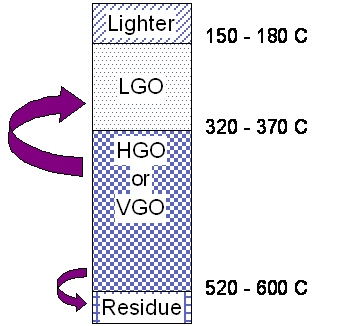
column, separation is achieved between residue, gasoil, and lighter products. In
addition, a heavy gasoil fraction is taken from the Combi Tower that is returned
to the Surge Drum, and then recycled through the Distillate Heater
The bottom product of the Combi
Tower is typically routed to a Vacuum Flasher. In the Vacuum Flasher, heavy
gasoil is recovered from the residue stream, and routed back to the Distillate
Heater. The vacuum flashed residue product from the Vacuum Flasher can be routed
to fuel oil blending, or can be used internally as refinery fuel.
Because heavy gasoil from both the Vacuum
Flasher and the Combi Tower is recycled to the Distillate Heater, all heavy
gasoil is converted. Light gasoil from the Combi Tower is first
stripped, and is then routed to a Hydrotreater. Alternatively, light gasoil can
be used as cutterstock.

Yield
Typical product yields from the Shell
Thermal Distillate Cracking process are: